Today is April 1st, but this is not an April Fools’ joke. I wish it were.
If you own a hardware wallet from Ledger or Trezor and you’re based in the UK, there’s a fair chance you’ve already hit this page:
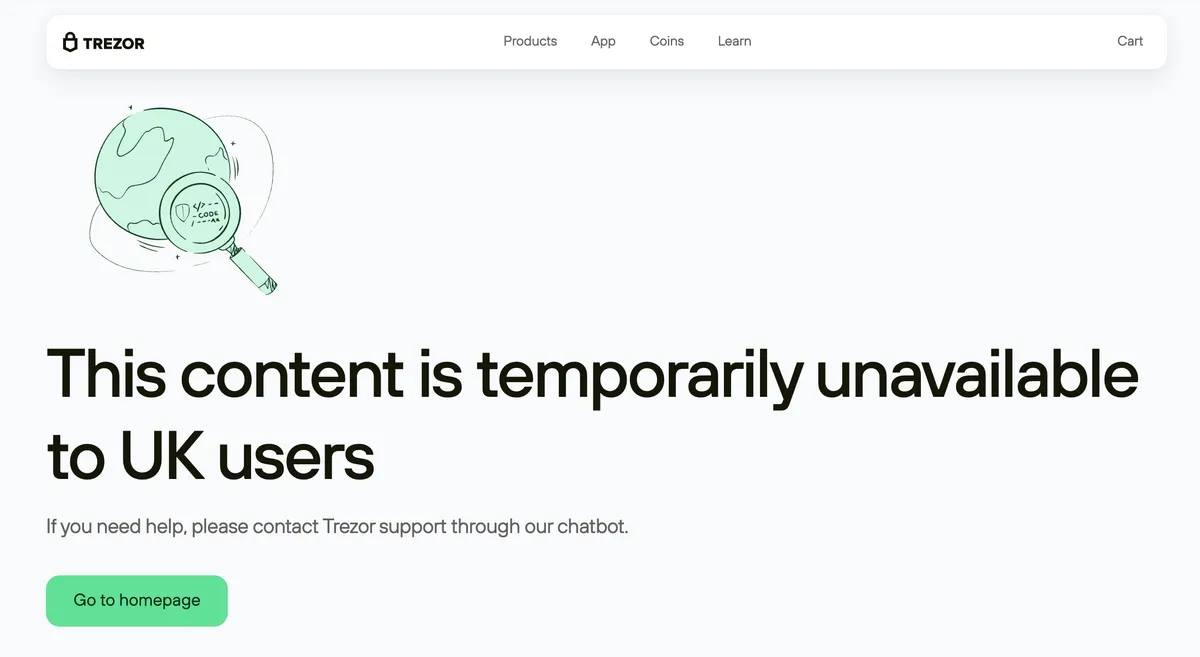
Both companies block specific content for UK visitors. But what’s striking is that the policy now extends far beyond the usual suspects - blocked pages on peer-to-peer trading, for example, would at least be predictable. Educational articles are now blocked too. Trezor’s page about UTXOs. Ledger’s guide to best practices for hardware wallet security. Even a guide to multisig.
This is the UK’s financial promotions regime in action.
Disclosure: Predictably I need to point out that this article is for general information only and does not constitute investment advice or a financial promotion.
1. What happened
The FCA’s financial promotion rules for cryptoassets came into effect in October 2023, and it covers any “invitation or inducement to engage in investment activity” involving a “qualifying cryptoasset”. Remember that the FCA is yet to make any distinction between Bitcoin - a decentralised global monetary network with a market cap approaching that of silver, running uninterrupted for over 17 years - and the latest pump & dump crypto coin.
Crucially, the offending content doesn’t need to target UK consumers to be liable. It just needs to be “capable of having an effect in the UK”: in other words, be publicly accessible on the internet.
Trezor is Czech, Ledger is French, and neither holds FCA authorisation. Breach is a criminal offence - up to two years’ imprisonment and an unlimited fine. Their response is predictable: geo-block anything that might, under a broad reading, constitute a financial promotion. It’s blunt, possibly overcautious, and not really their fault. The definition is capacious enough to catch almost anything. The criticism belongs with the regulation, not the companies.
2. What’s blocked
Trezor
I scanned 421 pages across Trezor’s site. Around 40 are blocked for UK visitors. They return HTTP 200 - so not even a proper error code - but serve a blank page instead of the article, with the heading: “This content is temporarily unavailable to UK users.”

Some blocked pages are predictable. Every guide to buying, selling, swapping, and staking crypto through Trezor Suite is gone. These probably do constitute financial promotions under the letter of the law, so it’s hardly surprising that they’re blocked.
But the block extends far beyond this.
| Blocked page | What it is |
|---|---|
| What is a hardware wallet? | An explanation of the product you just bought |
| Public & private keys | Cryptography fundamentals |
| What is a UTXO? | How Bitcoin transactions work |
| What is a change address? | Transaction mechanics |
| What is multisig? | Multi-signature security, widely used in inheritance planning |
| Using Bitcoin testnet with Trezor | Developer testing with fake coins |
Meanwhile, the pages explaining what CoinJoin is and how to use Tor with Trezor Suite are fine. So is the entire Trezor blog, including a post titled Unlock financial freedom in just 4 steps: master crypto security and be your own bank. Promoting financial freedom is apparently fine. Explaining what a change address is - not so much.
The sheer incongruity of the blocked pages suggests a hasty compliance exercise rather than deliberate targeting. Slapdash, in other words - the predictable result when loosely-written regulation meets a legal team working to a deadline.
Ledger
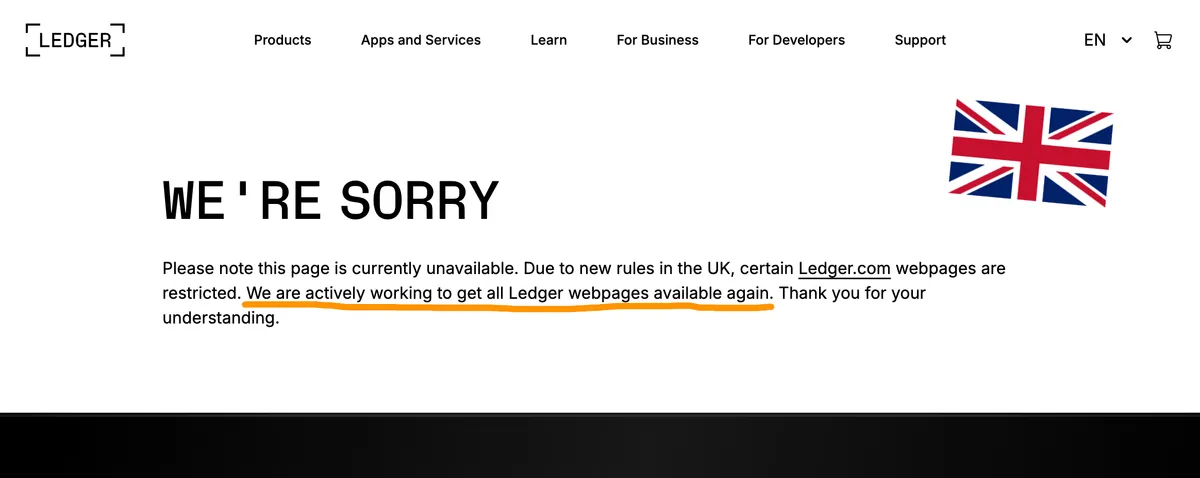
Ledger’s approach is simpler: block almost everything and work backwards. Their message: “Due to new rules in the UK, certain Ledger.com webpages are restricted. We are actively working to get all Ledger webpages available again.”
Their Academy landing page is accessible. The articles are not. Neither is the blog, nor /buy or /swap.
| Blocked page | What it is |
|---|---|
| What is a crypto wallet? | An explanation of the product you just bought |
| Bitcoin UTXOs explained | How Bitcoin transactions work |
| Best practices for using a hardware wallet | Security and safety advice |
| Which Ledger device is best for me? | Product selection guide |
| What is multisig? | A wallet security method |
| What is staking? | An explanation of how staking works |
An exception: multisig.ledger.com — the enterprise multisig product — is fully accessible. So you can purchase the product, you just can’t read about what multisig means.
For what it’s worth, Coldcard, BitBox, and many others don’t appear to be applying the same restrictions. Their educational content remains accessible to UK visitors. Whether that reflects a different legal reading, a different risk appetite, or simply a smaller compliance team’s to-do list, I don’t know.
3. The actual cost
The financial promotions regime wasn’t designed for this. It was meant to stop predatory crypto advertising: pump-and-dump scams, misleading yield claims, celebrity endorsements for projects whose entire value proposition is vibes. To my mind, that’s a legitimate goal.
Instead, it’s caught UK users who already own a hardware wallet and now can’t access the documentation to use it properly. Users are now less safe as a direct result of this legislation. Proper coin control requires an understanding of UTXOs and change addresses. Creating a resilient multisig setup for your family requires, at minimum, understanding what multisig is. None of this is promotional.
The FCA’s definition doesn’t distinguish between a tutorial on transaction mechanics and a flyer for a memecoin.

4. Getting around it
I have three options for you.
- The Wayback Machine (web.archive.org) has archived over 840 of Trezor’s knowledge base pages and 1,500+ of Ledger’s academy articles. Paste in the blocked URL, and you’ll usually find a cached version from late 2025 or early 2026. Free, no account required.
- A VPN (virtual private network) is more comprehensive - something like Proton VPN (no affiliate links). VPNs are legal in the UK. Connect to any non-UK server and you’ll see the full, live site. At the rate UK internet censorship is expanding, it’s becoming infrastructure rather than a luxury.
- The Google Translate proxy is the mildly absurd option that nobody asked for: prefix any blocked URL with
https://translate.google.com/translate?sl=auto&tl=en&u=and Google’s servers fetch it on your behalf. You get a slightly clunky but readable version of the article, routed through Mountain View. For example, you can go forth and learn about UTXOs using this link.
Wrapping up
This is par for the course. The UK government has form on this. The financial promotions regime is a reasonable idea, badly executed. The definition is broad enough to catch “what is a UTXO”, while the penalties are severe enough that companies have chosen geo-blocking as a catch-all fix. UK residents are left less informed about how to use technology they own.
The information is still out there - in textbooks, GitHub repos, Bitcoin meetups, and a thousand other websites the FCA hasn’t yet targeted as cryptoasset promotions. But while the UK government figures itself out, a VPN is now required.
Thanks for reading! If you’d like to support the site, you can do so by sending a few sats my way.
Scan with Tap to open your Bitcoin wallet, or copy the on-chain address below.
Scan with Tap to open your Lightning wallet, or copy my Lightning address below.